
BS Electrical Engineering
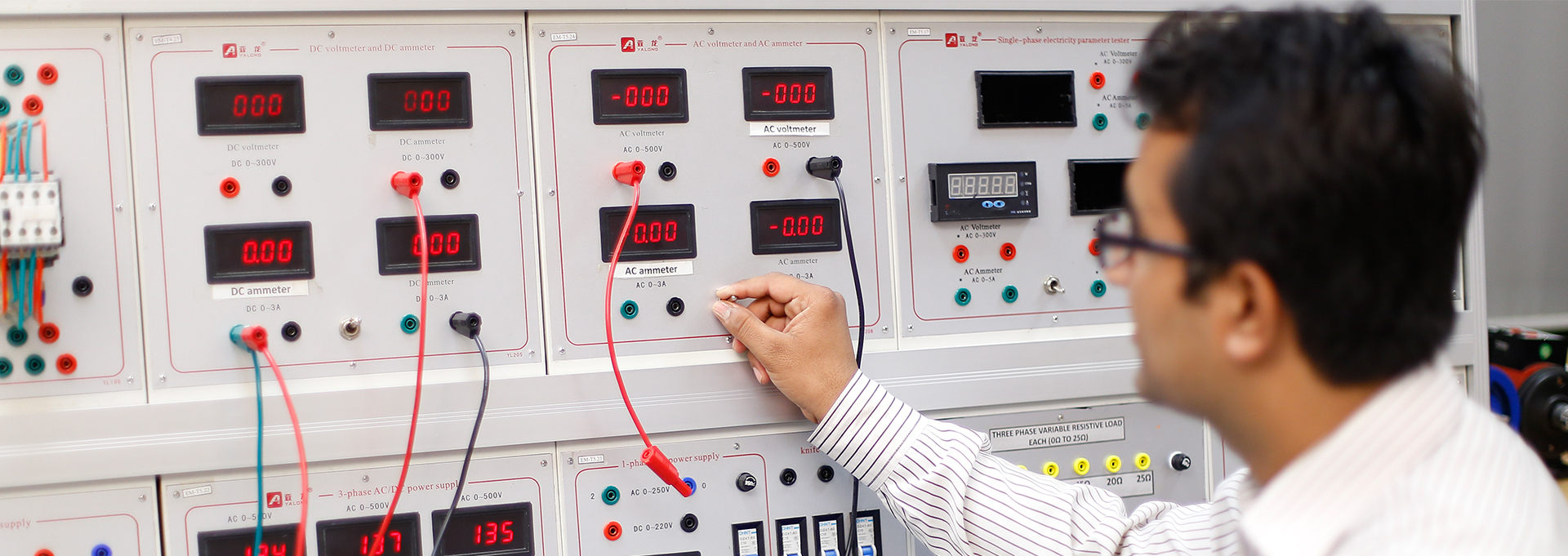
About The Program
Department of Electrical and Computer Engineering at Capital University of Science & Technology provides a strong foundation for those wishing to pursue a career in Electrical Engineering through a diverse range of theoretical skills and practical experience. Strong partnerships with industry and funded research provide great opportunities for undergraduate students to carry their research, projects and internships. Other pragmatic learning programs provide opportunities for students to gain relevant real-world experience during their program of study. In addition to the professional development of the students, a conducive environment is provided to enhance their personality and ethical values. This enables our Engineering graduates to positively contribute in their professional engineering career as well as in society. Faculty at the Department of Electrical and Computer Engineering, Capital University of Science and Technology, is highly qualified and vastly experienced. Most of the Faculty members are qualified from abroad and they are actively involved in teaching, research and industrial R&D. Our main areas of interest are Telecommunications, Control and Automation, Industrial and Power Electronics, Signal and Image Processing, Microwave Engineering, Computer Networks, Microelectronics, and Power Systems.
Admission Requirements
- Higher Secondary School Certificate (F.Sc. Pre-Engineering or Pre-Medical) or Equivalent with Physics, Chemistry and Mathematics securing at least 60% marks in aggregate
OR
Intermediate of Computer Science (ICS) or Equivalent with Physics, Computer Science and Mathematics securing at least 60% marks in aggregate
OR
Diploma of Associate Engineering in relevant disciplines securing at least 60% marks in aggregate. - CUST Admission Test or HEC Approved Test.
Degree Requirements
Each candidate for the BS Electrical Engineering degree is required to successfully earn 140 credit hours (Cr. Hrs.) as per the following detail:
| Area | Cr. Hrs. |
|---|---|
| a) General Education Courses | 45 |
| i) Natural Sciences | 18 |
| ii) Humanities | 20 |
| iii) Management Sciences | 04 |
| iv) Computer Science | 03 |
| b) Disciplinary or Major Courses | 70 |
| c) Interdisciplinary / Allied Courses | 16 |
| d) Field Experience / Internship | 03 |
| e) Capstone / Design Project | 06 |
| f) Community Service | 00 |
| Total | 140 |
General Education Courses (45 Cr. Hrs)
i) Natural Sciences
| Course Title | Code | Cr. Hrs. |
|---|---|---|
| Calculus and Analytical Geometry | EEG1513 | 3 |
| Probability and Statistics | EEG2523 | 3 |
| Applied Differential Equations | MTEE1043 | 3 |
| Complex Variables and Transforms | MTEE2053 | 3 |
| Linear Algebra | MTEE1033 | 3 |
| Applied Physics | EEG1312 | 2 |
| Applied Physics Lab | EEG1311 | 1 |
ii) Humanities
| Course Title | Code | Cr. Hrs. |
|---|---|---|
| Functional English | EEG1113 | 3 |
| Expository Writing | EEG1123 | 3 |
| Islamic Studies/Ethics | EEG1012 | 2 |
| Fehm-ul-Quran I | EEG1021 | 1 |
| Fehm-ul-Quran II | EEG1031 | 1 |
| Ideology and Constitution of Pakistan | EEG1022 | 2 |
| Pakistan Studies | EEG1032 | 2 |
| Personal Grooming | EEG1212 | 2 |
| Sociology | EEG1412 | 2 |
| Civics and Professional Ethics | EEG2812 | 2 |
iii) Management Sciences
| Course Title | Code | Cr. Hrs. |
|---|---|---|
| Project Management | MGTE4062 | 2 |
| Entrepreneurship | EEG2712 | 2 |
iv) Computer Science
| Course Title | Code | Cr. Hrs. |
|---|---|---|
| Applications of Information and Communication Technologies | EEG1612 | 2 |
| Applications of Information and Communication Technologies Lab | EEG1611 | 1 |
Disciplinary or Major Courses (70 Cr. Hrs.)
(a) Computer and Information Sciences (08 Cr. Hrs.)
| Course Title | Code | Cr. Hrs. |
|---|---|---|
| Data Structures and Algorithms | CSEE2133 | 3 |
| Data Structures and Algorithms Lab | CSEE2131 | 1 |
| Computer Programming | CSEE1123 | 3 |
| Computer Programming Lab | CSEE1121 | 1 |
b) EE Foundation Courses (24 Cr. Hrs.)
| Course Title | Code | Cr. Hrs. |
|---|---|---|
| Circuit Analysis | EE1213 | 3 |
| Circuit Analysis Lab | EE1211 | 1 |
| Electronic Devices and Circuits | EE2223 | 3 |
| Electronic Devices and Circuits Lab | EE2221 | 1 |
| Signals & Systems | EE2613 | 3 |
| Signals & Systems Lab | EE2611 | 1 |
| Electrical Network Analysis | EE2253 | 3 |
| Electromagnetic Fields & Waves | EE2513 | 3 |
| Digital Logic Design | EE2313 | 3 |
| Digital Logic Design Lab | EE2311 | 1 |
| Engineering Drawing | EE1011 | 1 |
| Workshop Practice | EE1021 | 1 |
c) EE Core (20 Cr. Hrs.)
| Course Title | Code | Cr. Hrs. |
|---|---|---|
| Microprocessor and Interfacing | EE3323 | 3 |
| Microprocessor and Interfacing Lab | EE3321 | 1 |
| Communication Systems | EE3713 | 3 |
| Communication Systems Lab | EE3711 | 1 |
| Electrical Machines | EE3283 | 3 |
| Electrical Machines Lab | EE3281 | 1 |
| Linear Control System | EE4813 | 3 |
| Linear Control System Lab | EE4811 | 1 |
| Power Distribution and Utilization | EE3143 | 3 |
| Power Distribution and Utilization Lab | EE3141 | 1 |
d) EE Core (18 Cr. Hrs.)
| Course Title | Code | Cr. Hrs. |
|---|---|---|
| Depth Elective-I | EE3xx3 | 3 |
| Depth Elective-I Lab | EE3xx1 | 1 |
| Depth Elective-II | EE3xx3 | 3 |
| Depth Elective-II Lab | EE3xx1 | 1 |
| Depth Elective-III | EE3xx3 | 3 |
| Depth Elective-IV | EE4xx3 | 3 |
| Depth Elective-IV Lab | EE3xx1 | 1 |
| Depth Elective-V | EE4xx3 | 3 |
Depth Elective Courses
| Course Title | Code | Cr. Hrs. |
|---|---|---|
| Antenna Theory & Design | EE4533 | 3 |
| Automotive Engineering | EExxx3 | 3 |
| Automotive Engineering Lab | EExxx1 | 1 |
| ASIC Design and FPGA | EE4273 | 3 |
| ASIC Design and FPGA Lab | EE4271 | 1 |
| Cloud and Distributed Computing | EE4443 | 3 |
| Computer Architecture | EE4353 | 3 |
| Computer Communications and Networks (CCNet) | EE4713 | 3 |
| Computer Communications and Networks (CCNet) Lab | EE4711 | 1 |
| Computer Vision | EE4683 | 3 |
| Design and Analysis of Algorithms | CSEE4143 | 3 |
| Digital Design Verification | EE4343 | 3 |
| Digital Image Processing | EE4633 | 3 |
| Digital Image Processing Lab | EE4631 | 1 |
| Digital Signal Processing | EE4623 | 3 |
| Digital Signal Processing Lab | EE4621 | 1 |
| Electric Vehicles | EE4413 | 3 |
| Embedded Systems | EE3333 | 3 |
| Embedded Systems Lab | EE3331 | 1 |
| EV Charging Devices and Technologies | EExxx3 | 3 |
| EV Charging Devices and Technologies Lab | EExxx1 | 1 |
| Hardware Security | EE4463 | 3 |
| HCI & Computer Graphics | CSEE4153 | 3 |
| Industrial Electronics | EE4263 | 3 |
| Industrial Electronics Lab | EE4261 | 1 |
| Internet of Things | EE4423 | 3 |
| Malware Analysis | EE4473 | 3 |
| Microwave Engineering | EE4523 | 3 |
| Network and Cyber Security | EE4743 | 3 |
| Network Design & Management | EE4763 | 3 |
| Numerical Analysis | EE2403 | 3 |
| Operating Systems | EE4323 | 3 |
| Operating Systems Lab | EE4321 | 1 |
| Penetration Testing | EE4482 | 2 |
| Penetration Testing Lab | EE4481 | 1 |
| Smart Grid & Renewable Energy Systems | EE4433 | 3 |
| Systems Programming | CSEE4163 | 3 |
| Systems Programming Lab | CSEE4161 | 1 |
| Theory of Automata | CSEE4173 | 3 |
| Vulnerability Assessment & Reverse Engineering | EE4492 | 2 |
| Vulnerability Assessment & Reverse Engineering Lab | EE4491 | 1 |
| Wireless Communication | EE4733 | 3 |
Interdisciplinary / Allied Courses – IDC (16 Cr. Hrs.)
a) Flexible Engineering/Non-Engineering (11 Cr. Hrs.)
| Course Title | Code | Cr. Hrs. |
|---|---|---|
| Electronics Circuit Design | EE2232 | 2 |
| Electronics Circuit Design Lab | EE2231 | 1 |
| Instrumentation and Measurements | EE3263 | 3 |
| Instrumentation and Measurements Lab | EE3261 | 1 |
| Artificial Intelligence | EE4693 | 3 |
| Artificial Intelligence Lab | EE4691 | 1 |
b) Multi-disciplinary Engineering (05 Cr. Hrs.)
| Course Title | Code | Cr. Hrs. |
|---|---|---|
| Basic Mechanical Engineering | MEEE3023 | 3 |
| Basic Mechanical Engineering Lab | MEEE3021 | 1 |
| Occupational Health & Safety | HMEE1071 | 1 |
Capstone / Design Project (06 Cr. Hrs.)
After the completion of 90 Cr. Hrs., the students are required to register for Design Project (Part-I) of 2 Cr. Hrs. in the 7th semester of their degree program. Design Project (Part-II) of 4 Cr. Hrs. can be taken in the next i.e. 8th semester provided Design Project (Part-I) is passed.
| Course Title | Code | Cr. Hrs. |
|---|---|---|
| Design Project (Part-I) | EE4912 | 2 |
| Design Project (Part-II) | EE4924 | 4 |
Field Experience / Internship (03 Cr. Hrs.)
Each student is required to complete 8 weeks industrial internship training usually after 6 semesters or on the completion of 75 Cr. Hrs.
| Course Title | Code | Cr. Hrs. |
|---|---|---|
| Field Experience / Internship | EE4003 | 03 |
Community Service (VIS4000)
Each student is required to complete 65 hours community work, usually after 1st semester which would be a prerequisite for the award of degree. It will be assessed as satisfactory (S) / unsatisfactory (US). In case of unsatisfactory, it will be done from scratch.
CGPA Requirement
A student is required to earn a minimum 2.00/4.00 CGPA on the completion of his/her degree requirements.
Program Duration
This is a four year degree program comprising of 8 semesters. There will be a Fall and a Spring semester in each year. The summer semester will be utilized for internship or deficiency courses. The maximum duration to complete BS Electrical Engineering degree is 07 years.
Semester-I (15 Cr. Hrs.)
| Course Code | Course Title | Cr. Hrs. | |
| EEG | 1612 | Applications of Information and Communication Technologies | 2 |
| EEG | 1611 | Applications of Information and Communication Technologies Lab | 1 |
| EEG | 1312 | Applied Physics | 2 |
| EEG | 1311 | Applied Physics Lab | 1 |
| EEG | 1513 | Calculus and Analytical Geometry | 3 |
| EE | 1011 | Engineering Drawing | 1 |
| EEG | 1113 | Functional English | 3 |
| EEG | 1012 | Islamic Studies/Ethics | 2 |
Semester-II (18 Cr. Hrs)
| Course Code | Course Title | Cr. Hrs. | |
| MTEE | 1043 | Applied Differential Equations | 3 |
| CSEE | 1123 | Computer Programming | 3 |
| CSEE | 1121 | Computer Programming Lab | 1 |
| MTEE | 1033 | Linear Algebra | 3 |
| EE | 1213 | Circuit Analysis | 3 |
| EE | 1211 | Circuit Analysis Lab | 1 |
| EEG | 1022 | Ideology and Constitution of Pakistan | 2 |
| HMEE | 1071 | Occupational Health and Safety | 1 |
| EE | 1021 | Workshop Practice | 1 |
Semester-III (18 Cr. Hrs)
| Course Code | Course Title | Cr. Hrs. | |
| EEG | 1212 | Personal Grooming | 2 |
| MTEE | 2053 | Complex Variables and Transforms | 3 |
| EE | 2253 | Electrical Network Analysis | 3 |
| EE | 2223 | Electronic Devices and Circuits | 3 |
| EE | 2221 | Electronic Devices and Circuits Lab | 1 |
| EEG | 2712 | Entrepreneurship | 2 |
| EEG | 1123 | Expository Writing | 3 |
| EEG | 1021 | Fehm-ul-Quran I | 1 |
Semester-IV (18 Cr. Hrs)
| Course Code | Course Title | Cr. Hrs. | |
| CSEE | 2133 | Data Structures and Algorithms | 3 |
| CSEE | 2131 | Data Structures and Algorithms Lab | 1 |
| EEG | 1412 | Sociology | 2 |
| EE | 2313 | Digital Logic Design | 3 |
| EE | 2311 | Digital Logic Design Lab | 1 |
| EE | 3283 | Electrical Machines | 3 |
| EE | 3281 | Electrical Machines Lab | 1 |
| EEG | 1031 | Fehm-ul-Quran II | 1 |
| EEG | 2523 | Probability and Statistics | 3 |
Semester-V (18 Cr. Hrs)
| Course Code | Course Title | Cr. Hrs. | |
| EEG | 2812 | Civics and Professional Ethics | 2 |
| EE | 2513 | Electromagnetic Fields and Waves | 3 |
| EE | 2232 | Electronics Circuit Design | 2 |
| EE | 2231 | Electronics Circuit Design Lab | 1 |
| EE | 3323 | Microprocessor and Interfacing | 3 |
| EE | 3321 | Microprocessor and Interfacing Lab | 1 |
| MGTE | 4062 | Project Management | 2 |
| EE | 2613 | Signals and Systems | 3 |
| EE | 2611 | Signals and Systems Lab | 1 |
Semester-VI (18 Cr. Hrs)
| Course Code | Course Title | Cr. Hrs. | |
| EE | 4693 | Artificial Intelligence | 3 |
| EE | 4691 | Artificial Intelligence Lab | 1 |
| EE | 3713 | Communication Systems | 3 |
| EE | 3713 | Communication Systems Lab | 1 |
| EE | 3xx3 | Depth Elective-I | 3 |
| EE | 3xx1 | Depth Elective-I Lab | 1 |
| EE | 3xx3 | Depth Elective-II | 3 |
| EE | 3xx1 | Depth Elective-II Lab | 1 |
| EEG | 1032 | Pakistan Studies | 2 |
Semester-VII (17 Cr. Hrs)
| Course Code | Course Title | Cr. Hrs. | |
| EE | 3263 | Instrumentation and Measurements | 3 |
| EE | 3261 | Instrumentation and Measurements Lab | 1 |
| MEEE | 3023 | Basic Mechanical Engineering | 3 |
| MEEE | 3021 | Basic Mechanical Engineering Lab | 1 |
| EE | 4912 | Design Project I | 2 |
| EE | 3143 | Power Distribution and Utilization | 3 |
| EE | 3141 | Power Distribution and Utilization Lab | 1 |
| EE | 4xx3 | Depth Elective III | 3 |
Semester-VIII (15 Cr. Hrs)
| Course Code | Course Title | Cr. Hrs. | |
| EE | 4924 | Design Project II | 4 |
| EE | 4813 | Linear Control Systems | 3 |
| EE | 4811 | Linear Control Systems Lab | 1 |
| EE | 4xx3 | Depth Elective IV | 3 |
| EE | 4xx1 | Depth Elective IV Lab | 1 |
| EE | 4xx3 | Depth Elective V | 3 |
The BS Electrical Engineering program aims to produce leading professionals who will:
| Sr. # | Statement |
|---|---|
| PEO-1 | Serve competently in national and international industry or academia by showing requisite knowledge and skills in the field of Electrical Engineering. |
| PEO-2 | Exhibit quest for learning and initiative through elevation in education or growth in professional status. |
| PEO-3 | Demonstrate commitment to ethical practices, community service and societal contribution. |
At the time of graduation the graduates of BS Electrical Engineering program will possess the following attributes:
| Sr. # | Learning Outcomes | Statement |
|---|---|---|
| PLO-1 | Engineering Knowledge |
An ability to apply knowledge of mathematics, science, engineering fundamentals and an engineering specialization to the solution of complex engineering problems. |
| PLO-2 | Problem Analysis |
An ability to identify, formulate, research literature, and analyze complex engineering problems reaching substantiated conclusions using first principles of mathematics, natural sciences and engineering sciences. |
| PLO-3 | Design/Development of Solutions |
An ability to design solutions for complex engineering problems and design systems, components or processes that meet specified needs with appropriate consideration for public health and safety, cultural, societal, and environmental considerations. |
| PLO-4 | Investigation |
An ability to investigate complex engineering problems in a methodical way including literature survey, design and conduct of experiments, analysis and interpretation of experimental data, and synthesis of information to derive valid conclusions. |
| PLO-5 | Modern Tool Usage |
An ability to create, select and apply appropriate techniques, resources, and modern engineering and IT tools, including prediction and modeling, to complex engineering activities, with an understanding of the limitations. |
| PLO-6 | The Engineer and Society |
An ability to apply reasoning informed by contextual knowledge to assess societal, health, safety, legal and cultural issues and the consequent responsibilities relevant to professional engineering practice and solution to complex engineering problems. |
| PLO-7 | Environment and Sustainability |
An ability to understand the impact of professional engineering solutions in societal and environmental contexts and demonstrate knowledge of and need for sustainable development. |
| PLO-8 | Ethics |
Apply ethical principles and commit to professional ethics and responsibilities and norms of engineering practice. |
| PLO-9 | Individual and Team Work |
An ability to work effectively, as an individual or in a team, on multifaceted and /or multidisciplinary settings. |
| PLO-10 | Communication |
An ability to communicate effectively, orally as well as in writing, on complex engineering activities with the engineering community and with society at large, such as being able to comprehend and write effective reports and design documentation, make effective presentations, and give and receive clear instructions. |
| PLO-11 | Project Management |
An ability to demonstrate management skills and apply engineering principles to one’s own work, as a member and/or leader in a team, to manage projects in a multidisciplinary environment. |
| PLO-12 | Lifelong Learning |
An ability to recognize importance of, and pursue lifelong learning in the broader context of innovation and technological developments. |