Final Year Projects Funded (FYPs Funded) Details
The Office of Research, Innovation, and Commercialization (ORIC) is pleased to announce the selection of various projects for funding, with each project receiving a grant of PKR 50,000. These projects have been chosen based on their potential impact, innovation, and alignment with our mission to foster commercialization. Detailed information about each funded project, showcasing the diverse range of ideas and initiatives that contribute to our community’s growth and advancement, is provided below.
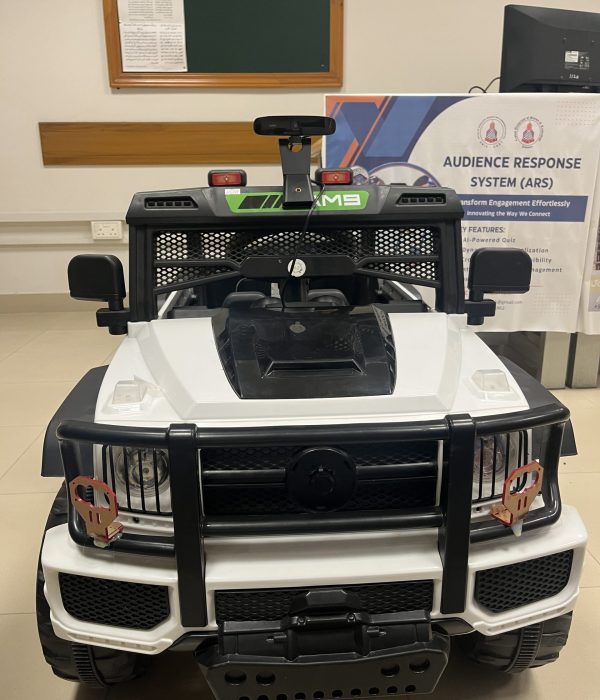
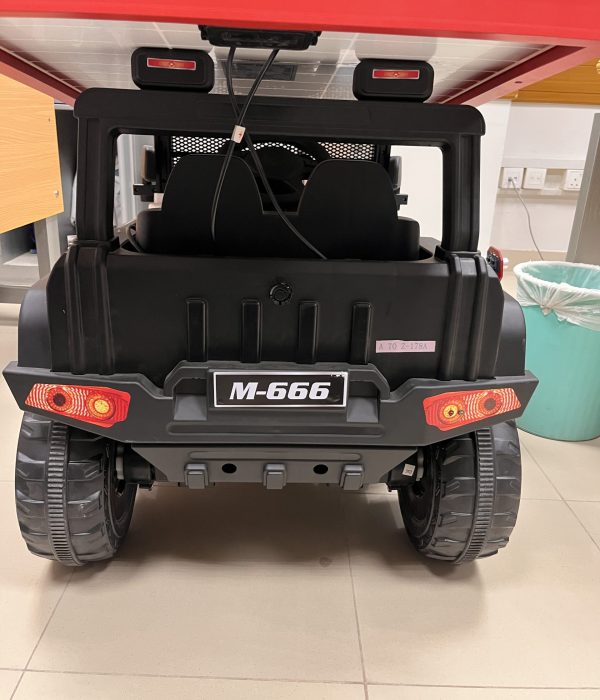
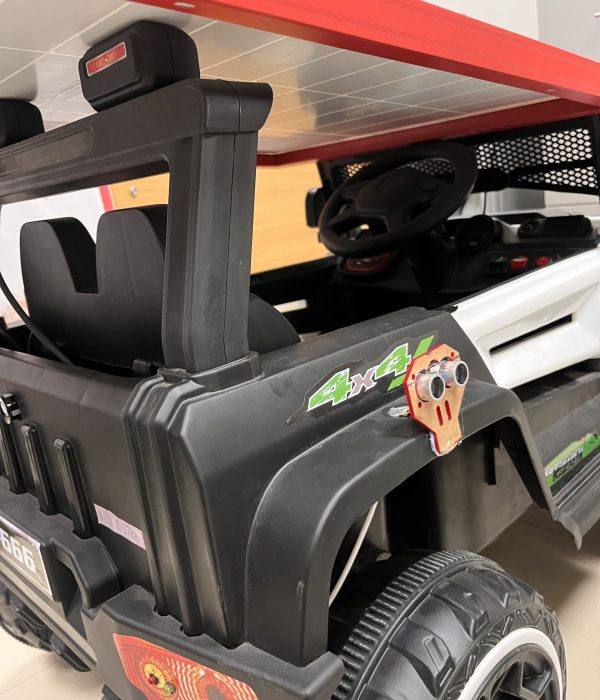
Project Title : Smart Solar Vehicle – Innovating Sustainable Transportation
Group Members
Muhammad Mudassar (BSE213195)
Muhammad Faizan Satti (BSE213168)
Muhammad Waleed (BSE213196)
Supervisor Name: Mr. Syed Awais Haider
Project Description
The Smart Solar Vehicle is an eco-friendly, autonomous prototype designed to tackle campus transportation challenges using solar energy. It integrates Raspberry Pi 4, ultrasonic sensors, a GPS module, and a camera for real-time path planning and obstacle detection. The system operates through a Flask-based interface enabling manual control and live monitoring. YOLOv11, a deep-learning model, allows the vehicle to identify and respond to pedestrians and road conditions effectively. The goal is to promote green mobility solutions by combining embedded systems, computer vision, and sustainable energy. The project demonstrates a practical model for localized, low-speed transportation in universities and industrial parks.
Features
- Autonomous navigation with GPS support
- Obstacle detection using ultrasonic sensors
- Real-time object detection using YOLOv11
- Solar energy-powered operation
- Web-based control interface via Flask
- Sensor data logging and live tracking
- Secure access via password-protected dashboard
- Modular system architecture for scalability
Unique Features
- Integration of YOLOv11 for real-time pedestrian recognition
- Kalman Filter implementation for sensor data accuracy
- Solar panel-powered system with energy efficiency modeling
- Web-based live camera stream and sensor monitoring
- Multithreaded control to manage real-time sensor and vision inputs
- Use of lightweight, weatherproof ultrasonic sensors (AJ-SR04M)
- Fused sensor and vision-based decision making for obstacle avoidance
Technical Description
The hardware includes Raspberry Pi 4 Model B as the central processor, interfacing with AJ-SR04M and HC-SR04 ultrasonic sensors, a 5MP Pi Camera, and a NEO-6M GPS module. Power is supplied by a 50W solar panel and a rechargeable battery setup. The software stack includes Python 3.9 with OpenCV for image processing, Flask for dashboard interface, and TensorFlow Lite for YOLOv5 object detection. The control logic is divided into modular services for vision, sensors, and navigation. The system logs data using SQLite and displays real-time values through a web dashboard. The prototype is tested under real-world scenarios with active path detection and live sensor fusion using Kalman Filters.
Project Title : Brick Sense-Image Based Brick Strength Prediction Using Deep Learning
Group Members
Ammar Ahmed (BCE213033)
Adnan Adil (BCE213060)
Usama Mumtaz (BCE213107)
Supervisor Name: Engr. Talha Bin Tahir
Project Description
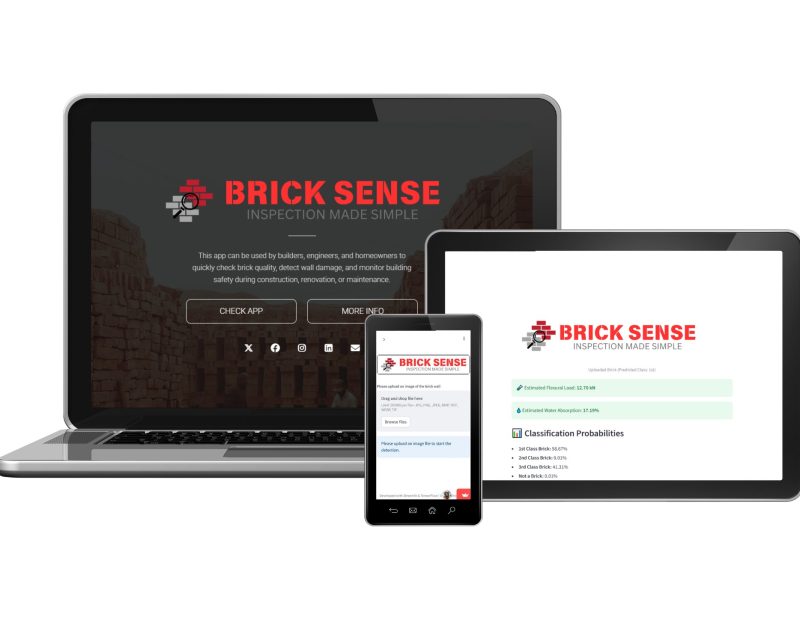
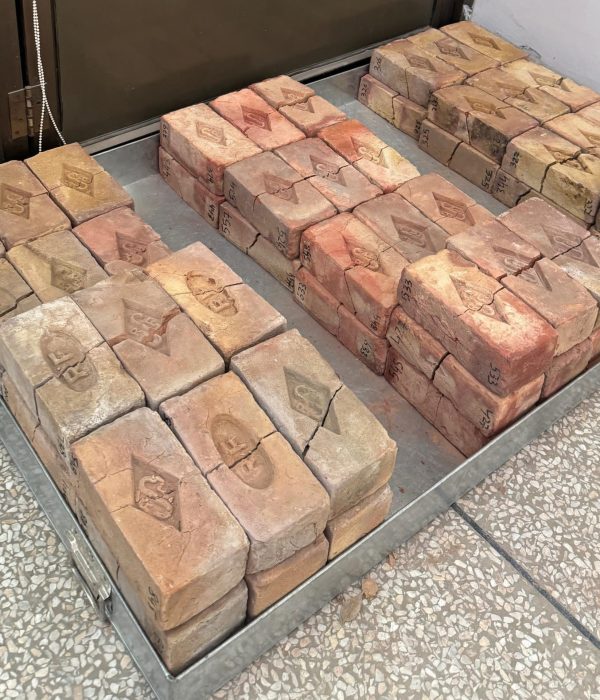
Brick Sense is an AI-driven inspection platform designed to modernize construction quality assessment. By analyzing simple images of bricks and walls, it automates classification, defect detection, and even predicts strength and durability properties. The goal is to replace slow, costly, and equipment-heavy testing methods with a fast, accessible, and reliable digital solution, empowering builders, engineers, and contractors to ensure higher construction standards with just a smartphone.
Features
- Brick Classification: Categorizes bricks into 1st, 2nd or 3rd class
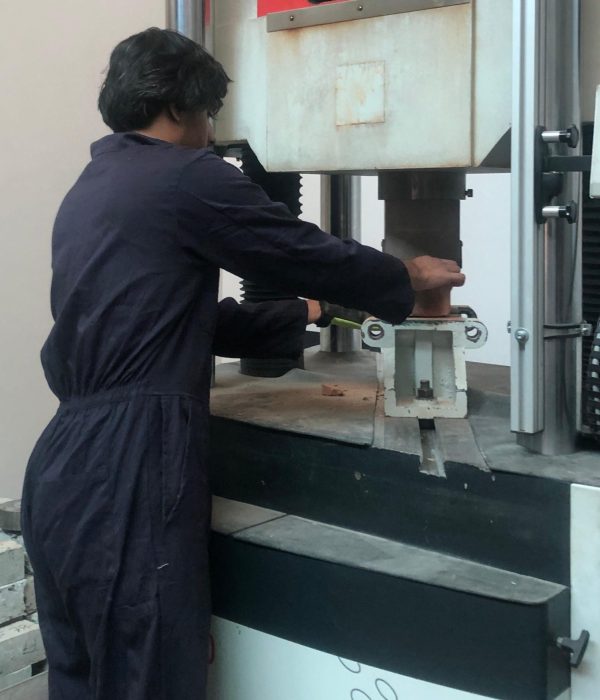
- Strength & Durability Prediction: Estimates mechanical properties from visual cues
- Defect & Wall Inspection: Detects cracks, chips, and irregularities in entire wall sections
- Device-Agnostic Access: Works on any device with a camera and internet connection
- Instant Feedback: Provides real-time results after image upload
Unique Features
- No Specialized Equipment: Only a smartphone or camera is required
- Lightweight Deployment: Runs on Streamlit’s cloud server, ensuring accessibility without infrastructure costs
- Explainable AI: Uses Grad-CAM to visually highlight cracks and weak spots, building user trust
- Privacy by Design: Images are processed instantly and discarded, ensuring data security
Technical Description
Brick Sense is powered by a custom Convolutional Neural Network (CNN) trained specifically on brick and wall imagery. The backend leverages TensorFlow for AI inference, while the Streamlit framework provides a simple, interactive web interface. Hosted on Streamlit’s free cloud service, the system follows a client-cloud model: users upload images, the CNN processes them in the cloud, and results are returned instantly.
To enhance transparency, Brick Sense integrates Grad-CAM for crack localization and defect explainability. This overlays heatmaps on images, showing exactly where the AI focused when making predictions. By merging defect detection with wall-wide inspection, the platform delivers both micro-level (brick) and macro-level (wall) insights—transforming it from a diagnostic tool into a decision-support system for the construction industry.